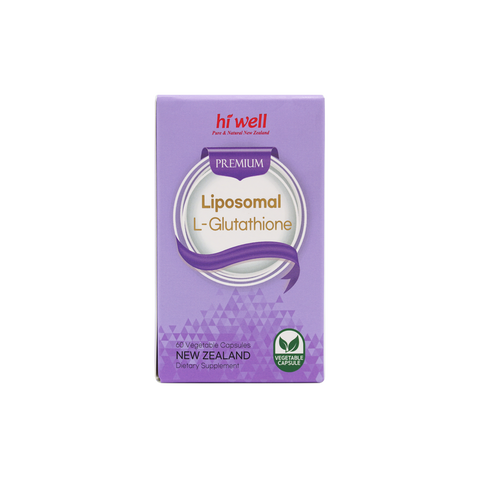

Looking for glutathione supplements in NZ or wondering what the difference is between glutathione and liposomal glutathione? These terms often appear together, but they do not describe two completely different ingredients.
Glutathione is a naturally occurring compound found in the body, while “liposomal” describes a delivery format designed to carry glutathione using lipid-based particles. Understanding that difference can make supplement labels much easier to compare.
This guide explains what glutathione is, what it does in the body, how liposomal glutathione differs from standard oral forms, and what to look for when comparing supplements.
What Is Glutathione?
Glutathione is a small molecule made from three amino acids: glutamate, cysteine, and glycine. Because of this structure, it is often described as a tripeptide.
The body produces glutathione naturally, and it is involved in a number of normal cellular processes. One of its best-known roles is helping maintain antioxidant defence and normal cellular redox balance.
In simple terms, glutathione is part of the body’s own system for managing oxidative reactions that occur as part of everyday metabolism.
Research reviews also describe glutathione as being involved in cellular antioxidant activity, redox regulation, protein protection, and several metabolic processes. :contentReference[oaicite:0]{index=0}
What Does Glutathione Do in the Body?
Glutathione is found throughout the body and works inside cells as part of normal antioxidant and metabolic systems.
It is involved in processes such as:
- maintaining normal cellular redox balance
- participating in antioxidant defence
- helping protect cellular proteins from oxidation
- supporting normal metabolic processing of certain compounds
- recycling between reduced and oxidised forms as part of normal cellular activity
Because glutathione is involved in many cellular processes, it has become a widely researched compound in nutrition, biochemistry, and supplement science. However, that does not mean an oral glutathione supplement should be expected to produce a specific medical or therapeutic outcome.
What Is Liposomal Glutathione?
Liposomal glutathione contains glutathione as the active ingredient, but the way it is delivered is different.
A liposome is a small structure made from phospholipids, which are similar to the lipids found in cell membranes. In supplement formulations, these lipid-based structures are used to carry ingredients through the digestive system.
The idea behind liposomal delivery is to help protect the ingredient during digestion and improve how it is presented for absorption. This delivery approach is also used with other nutrients and supplement ingredients.
So, the important point is this: liposomal glutathione is still glutathione. The difference is mainly the delivery system.
Glutathione vs Liposomal Glutathione
The easiest way to compare the two is to look at the formulation rather than treating them as different active ingredients.
| Feature | Standard Glutathione | Liposomal Glutathione |
|---|---|---|
| Active ingredient | Glutathione | Glutathione |
| Delivery format | Conventional oral formulation | Glutathione carried in a lipid-based delivery system |
| Common formats | Capsules, tablets, powders, liquids | Liquids or specialised capsule formulations |
| Main point to compare | Amount per serving, ingredients, format | Amount per serving, liposomal formulation, additional ingredients |
| Research interest | Oral glutathione absorption and metabolism | Whether lipid-based delivery changes oral bioavailability |
Does Liposomal Glutathione Absorb Better?
This is one of the most common questions around liposomal glutathione, but the answer is not as simple as saying one form is always better.
A small human pilot study published in 2018 looked at oral liposomal glutathione in 12 healthy adults. The researchers observed increases in glutathione levels in several blood compartments during the study, but the sample size was small, so the findings should be viewed as preliminary rather than definitive. :contentReference[oaicite:1]{index=1}
More recently, a 2026 randomized crossover pilot study compared standard, liposomal, and micellar glutathione formulations in 14 healthy adults. This type of research is useful because it compares different oral delivery systems directly, but the study was also small and should not be taken as proof that one format is universally superior. :contentReference[oaicite:2]{index=2}
For customers, the practical takeaway is that liposomal delivery is an area of ongoing research. It is reasonable to compare the format, but it is better to avoid assuming that every liposomal product will automatically provide a better result.
What Should You Look for in a Glutathione Supplement?
If you are comparing glutathione supplements in NZ, there are several details worth checking on the label:
- Form of glutathione: Check whether the product uses standard or liposomal glutathione.
- Amount per serving: Compare how much glutathione is provided per recommended serving.
- Product format: Some customers prefer capsules, while others prefer liquids or powders.
- Added ingredients: Glutathione products may also include vitamin C, selenium, amino acids, or other nutrients depending on the formulation.
- Serving directions: Compare how often the product is taken and how many capsules, tablets, or millilitres are required per serving.
- Storage: Some specialised formulations may have particular storage instructions.
Is Glutathione the Same as an Antioxidant Supplement?
Glutathione is commonly discussed in the context of antioxidant research because of the role it plays in normal cellular redox processes.
However, “antioxidant supplement” is a much broader category. Other nutrients and compounds, such as vitamin C, vitamin E, selenium, CoQ10, and plant-based antioxidants, are also found in this category.
That means glutathione should be considered as one option within a much broader antioxidant supplement category rather than as a replacement for all other antioxidant nutrients.
Standard or Liposomal: Which One Should You Choose?
There is no single format that is automatically the right choice for everyone.
Some customers may prefer a standard capsule because it is simple and familiar. Others may be interested in liposomal formulations because they want to compare newer delivery formats.
The more useful comparison is usually the full product: the amount of glutathione per serving, the formulation, additional ingredients, serving directions, price, and whether the format fits easily into your routine.
That is generally more helpful than choosing a product simply because the word “liposomal” appears on the front of the label.
Glutathione Supplements at Health NZ
Health NZ currently carries a limited selection of glutathione supplements, so this guide is designed primarily to help customers understand the ingredient rather than compare a long list of products.
If you are browsing our current glutathione option, the same comparison points above are useful: check whether the product uses standard or liposomal glutathione, review the amount per serving, look at any additional ingredients, and read the serving directions carefully.
As with any supplement, the most useful product is the one that suits your own routine and preferences rather than the one with the most complicated label.
Further Reading
For customers who would like to learn more, this review article discusses glutathione metabolism, antioxidant defence, and its role in cellular redox balance: Glutathione metabolism and antioxidant research on PubMed.
This human pilot study looks at oral liposomal glutathione and changes in glutathione levels following supplementation: Liposomal glutathione human study on PubMed.
For more recent research, this randomized crossover pilot study compares standard, liposomal, and micellar forms of oral glutathione: Oral glutathione formulation comparison on PubMed.
Important Note
Always read the label and use only as directed. Supplements are not a replacement for a balanced diet. If you are pregnant, breastfeeding, taking prescription medication, or if in doubt, please consult your healthcare professional before use.